Course Information
About
This course gives a solid understanding of the principles and abstractions used in computer systems and machine programs using C. Towards this aim, it covers a broad range of topics, providing students with an in-depth perspective and programming experience regarding the basic topics of C language and how programs are formed and executed at the microprocessor-level.
Upon the completion of COMP201, student will be able to (1) demonstrate proficiency in writing C programs that require effective memory management, (2) gain a deep knowledge of the compilation flow and runtime behavior of C programs, (3) have a clear understanding of computer arithmetic in a modern computing system, (4) recognize the relationship between a C program and its assembly translation, and (5) gain a general sense of working in a Unix environment as a power user, getting familiar with shell tools, version control systems, compilers, debuggers, profilers.
The course is taught by Aykut Erdem, Ali Kerem Bozkurt, Burak Kizil, Deniz Bilge Akkoc, Enes Sanli.

Time and Location
Lectures: Tuesday, Thursday at 16:00-17:10 (SOS B07)
Labs: Friday at 12:00-13:40 (Lab A) (SNA B242), 08:00-09:40 (Lab B) (SNA B242)
Reference Books
- Randal E. Bryant and David R. O’Hallaron, Computer Systems: A Programmer’s Perspective, Third Edition, Pearson, 2016
- The C Programming Language, Kernighan and Ritchie
- Nick Parlante, Essential C, Stanford CS Library, 2003
- Nick Parlante, Julie Zelenski and others, Unix Programming Tools, Stanford CS Library, 2001
- Anish Athalye, Jon Gjengset and Jose Javier Gonzalez Ortiz, The Missing Semester of Your CS Education, MIT, 2020
Policies: All work on assignments must be done individually unless stated otherwise. You are encouraged to discuss with your classmates about the given assignments, but these discussions should be carried out in an abstract way. That is, discussions related to a particular solution to a specific problem (either in actual code or in the pseudocode) will not be tolerated.
In short, turning in someone else’s work, in whole or in part, as your own will be considered as a violation of academic integrity. Please note that the former condition also holds for the material found on the web as everything on the web has been written by someone else.
Communication
The course webpage will be updated regularly throughout the semester with lecture notes, presentations, assignments and important deadlines. All other course related communications will be carried out through Blackboard.
Pre-requisites
COMP201 is open to second-year undergraduate students. Non-COMP students should ask the course instructor for approval before the add/drop period. The prerequisites for this course is COMP 132 - Advanced Programming.
Course Requirements and Grading
Grading will be based on
- 7 labs (your lowest 2 scores dropped, no make-up) (10%),
- 2 lab exams (10%) (5% each, no make-up)
- 5 programming assignments (17%) (Assignment0 1%, the others 4% each),
- Midterm exam (28%)
- Final exam (30%), and
- Class participation (5%)
Schedule
| Date | Topic | Notes |
| Feb 10 | Introduction. Course logistics, A tour of C programs (slides) (code) | B&O 1 Additional Reading: The Strange Birth and Long Life of Unix, Warren Toomey, IEEE Spectrum, 28 Nov 2011 “A damn stupid thing to do”—the origins of C, Arstechnica |
| Feb 12 | Bits and Bytes, Representing and Operating on Integers (slides) (code) | B&O 2.2-2.3 Additional Readings:
|
| Feb 13 | Bootcamp: Programming with C and Git basics | |
| Feb 17 | Bits and Bitwise Operators (slides) (code) Assg0 out: Getting Started with Unix and C |
B&O 2.1 |
| Feb 19 | Floating point (slides) (code) | B&O 2.4 Additional Reading: What Every Computer Scientist Should Know About Floating-Point Arithmetic, David Goldberg, ACM Computing Surveys, 23(1), 1991 Demos: |
| Feb 20 | Lab 1: The Linux Shell (slides) | MIT MS The Shell Stanford CS107 Unix videos 1-15, 24, 25 |
| Feb 24 | Chars and Strings in C (slides) (code) Assg0 in, Assg1 out: Strings in C |
K&R 1.9, 5.5, Appx B3 |
| Feb 26 | More Strings, Pointers (slides) (code | K&R 1.6, 5.5, Essential C 3 (strings and string.h library functions, The mechanics of pointers and arrays) |
| Feb 27 | Lab 2: C-Strings and GDB (slides) | Stanford CS107 Unix videos 26< |
| Mar 3 | Arrays and Pointers (slides) (code) | K&R 5.2-5.5, Essential C 6 (Advanced pointers) |
| Mar 5 | The Stack and The Heap (slides) | K&R 5.6-5.9, Essential C 6 (The heap) |
| Mar 6 | Lab 3: Arrays, Pointers, and Valgrind (slides) | Stanford CS107 Unix videos 27 Harvard CS50 short on GDB |
| Mar 10 | Realloc, Memory Bugs (slides) (code) Assg1 in, Assg2 out: Heap Management |
K&R 5.6-5.9, Essential C 6 (The Heap) |
| Mar 12 | void *, Generics (slides) (code) | K&R 5.6-5.9, Essential C 6 (The Heap) |
| Mar 13 | No labs this week | |
| Mar 17 | No class -- Spring Break | |
| Mar 19 | No class -- Spring Break | |
| Mar 20 | No labs this week -- Spring Break | |
| Mar 24 | Function Pointers (slides) (code) | K&R 5.11 |
| Mar 26 | const, Structures (slides) (code) | K&R 6.1-6.7 |
| Mar 27 | Lab Exam 1 | |
| Mar 31 | Compiling C programs (slides) (code) Assg2 in |
Stanford Unix Programming Tools 1 |
| Apr 2 | Introduction to x86-64, Data Movement (slides) (code) | B&O 3.1-3.4 Additional reading:
|
| Apr 3 | Lab 4: Structs, Working with multiple files, writing your own Makefiles (slides) | |
| Apr 7 | Arithmetic and Logic Operations (slides) | B&O 3.5-3.6 |
| Apr 9 | Midterm Review | |
| Apr 10 | No lab this week | |
| Apr 9 | Midterm Exam (Midterm Exam Guide) | |
| Apr 14 | x86-64 Control Flow (slides) Assg3 out: Defusing a Binary Bomb |
B&O 3.6.1-3.6.2 |
| Apr 16 | More Control Flow (slides) | B&O 3.6.3-3.6.8 |
| Apr 17 | Lab 5: Machine Programming with Assembly (slides) | |
| Apr 21 | x86-64 Procedures (slides) (code) | B&O 3.7 |
| Apr 23 | No classes - National Sovereignty and Children ’s Day | |
| Apr 24 | Lab 6: Runtime Stack (slides) | |
| Apr 28 | Data and Stack Frames (slides) Assg3 in |
B&O 3.8-3.9 |
| Apr 30 | Security Vulnerabilities (slides) (code) | B&O 3.10 Additional Reading: Smashing the Stack for Fun and Profit, Aleph One |
| May 1 | No labs this week | |
| May 5 | Cache Memories Assg4 out: Buffer Overflow Attacks |
B&O 6.1-6.4.2 |
| May 7 | More Cache Memories | B&O 6.4-6.7 Demos: Cache Simulator |
| May 8 | Lab Exam 2 | |
| May 12 | Optimization (code) | B&O 5 |
| May 14 | Linking | B&O 7 |
| May 15 | No labs this week | |
| May 19 | No classes - Commemoration of Atatürk, Youth and Sports Day Assg4 in |
|
| May 21 | Wrapping Up | |
| May 22 | Lab 7: Cache Memories, Code Optimization | |
| Jan 15 | Final Exam |
Resources
- Docker container for a development environment in COMP201
- Stanford CS107 Reader
- COMP201 Coding Style Guide for C Programming
- Guide on using LinuxPool
- UNIX Tutorial for Beginners
- Unix/Linux Command Reference
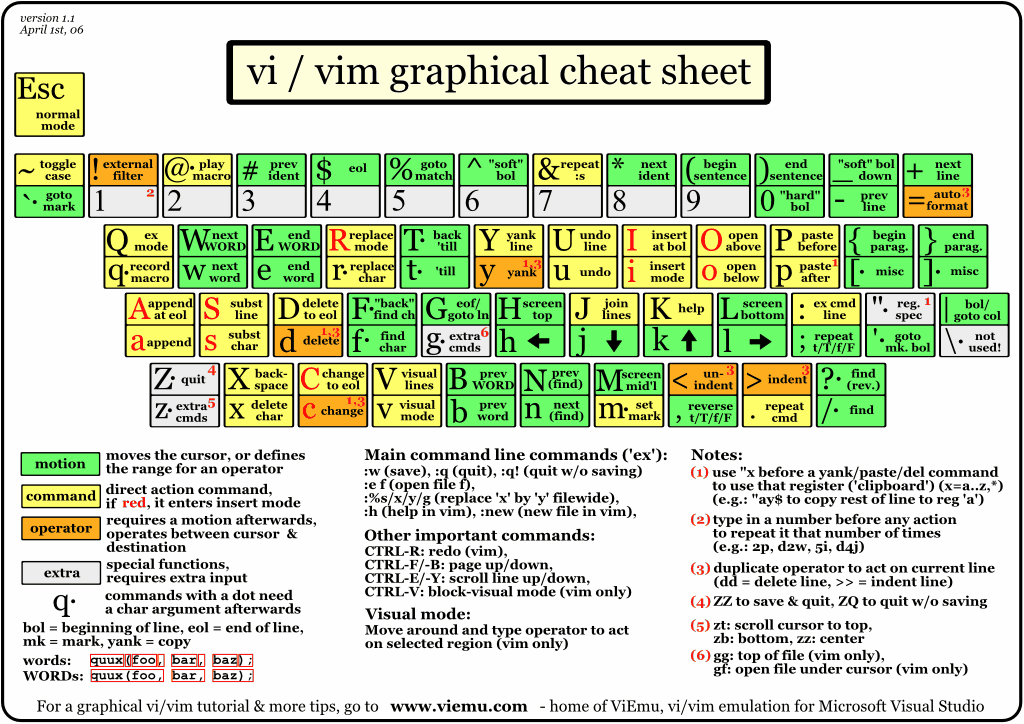
- Vi/Vim Cheat Sheet
- Harvard CS61 GIT Guide
- Stanford CS107 Valgrind Guide
- Brown CSCI0330 gdb Cheatsheet
- Stanford CS107 Guide to Make
- Stanford CS107 Guide to x86-64
- CMU 15-213 x86-64 Machine-Level Programming
- Stanford CS107 x86-64 Reference Sheet